Microbial archives become hard to govern long before they become large. The first real failure point is not freezer capacity. It is uncertainty about where a strain is stored, how many retrievable aliquots remain, and whether the next handoff can be reconstructed later. That is why cryostorage software has to solve traceability, not just location labeling.
Why freezer maps are not enough
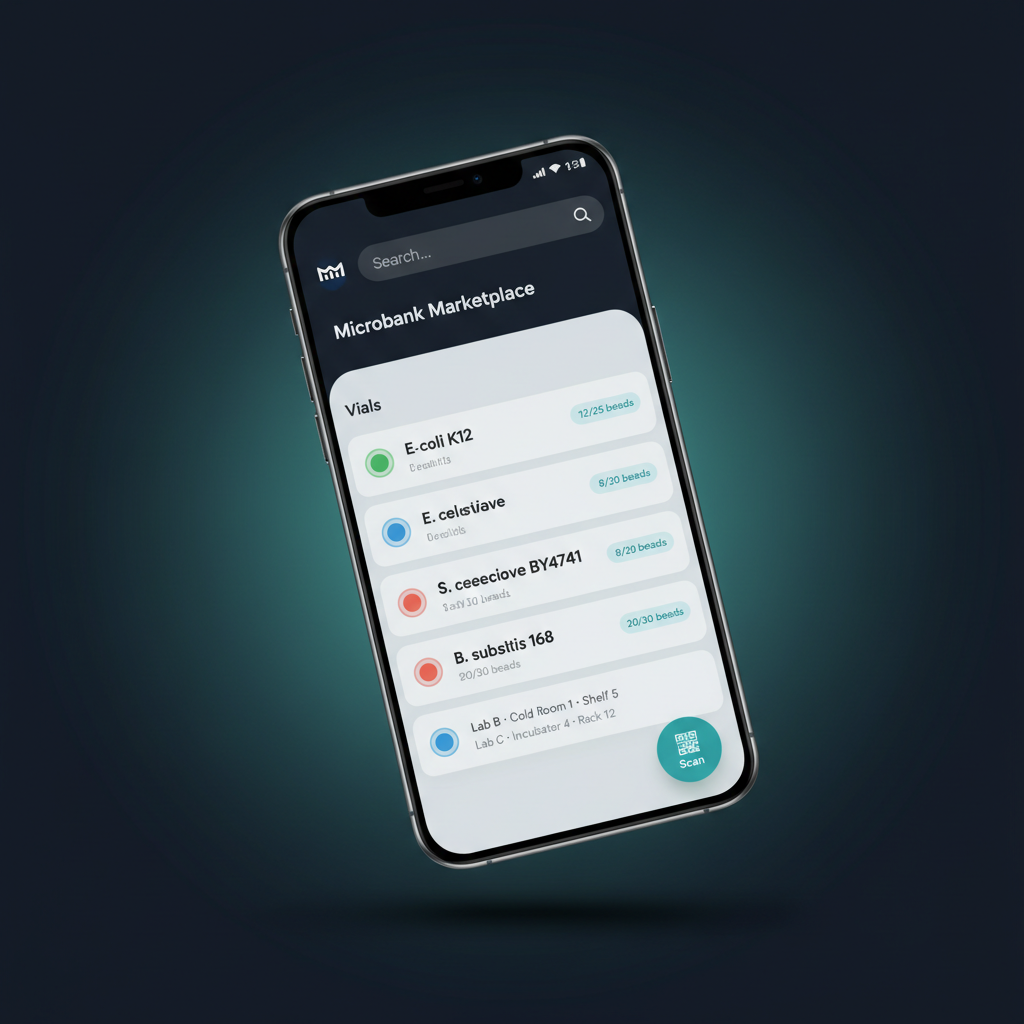
A box map answers where a vial should be. It does not answer whether the vial was moved, how many sub-aliquots remain, or which team retrieved the last sample. Labs managing Microbank workflows often need bead-level history because a single vial represents many future recoveries. That is the core reason Microbank Marketplace exists as a cryostorage traceability system rather than a generic freezer spreadsheet.
- Lab → freezer → shelf → rack → box → vial hierarchy
- Per-vial audit history for check-in, relocation, and retrieval
- Bead or sub-aliquot count awareness for recurring access workflows
- Mobile-first scanning for work done at the freezer, not at a desk later
- Optional marketplace workflows for controlled peer strain exchange
Culture collections need retrievability and proof
Biobanks and culture collections are routinely asked two practical questions: can the strain be located immediately, and can the archive prove what happened to it over time? Those are separate requirements. Good location control without a usable audit trail still leaves a blind spot during investigations or transfer events.
Traceability works best with adjacent controls
Teams preserving strains in regulated or semi-regulated environments often pair Microbank Marketplace with Pro-Temp for freezer condition records and Pro-LIMS Inventory for controlled reagents, CAPA, and supporting documentation.
Where peer exchange creates metadata problems
Lab-to-lab strain sharing has existed for decades, but many groups still manage it through email threads and handwritten notes. That process is workable until provenance, shipping history, or ownership questions appear. A marketplace model only improves operations if the listing and transfer history are kept inside the same traceability system as the frozen stock.
Evaluation criteria for microbial archive software
- Does the platform reflect how microbiology staff actually retrieve isolates?
- Can the system track remaining recoveries from a single stored vial?
- Can freezer locations be updated in real time from a phone at point of use?
- Can exported records support external review or collection governance?
- Can the archive connect storage events to monitoring records from Pro-Temp when excursions affect viability risk?
Conclusion
Microbial traceability has become a software problem because modern collections cannot rely on memory and static maps alone. For labs, biobanks, and collections that need vial-level cryostorage control and future-ready strain exchange, Microbank Marketplace is the main product page that should rank for that intent. It is strongest when used alongside robust freezer management and compliance records in the rest of the Pro-Lab stack.